Showing posts with label Concrete. Show all posts

CALCULATE QUANTITIES OF MATERIALS FOR CONCRETE

Quantities of materials for the production of required quantity of concrete of given mix proportions can be calculated by absolute volume method. This method is based on the principle that the volume of fully compacted concrete is equal to the absolute volume of all the materials of concrete, i.e. cement, sand, coarse aggregates and water.
concrete-materials-calculation-for-any-volume
The formula for calculation of materials for required volume of concrete is given by:
quantities-of-mateirals-for-concrete-formula
Where, Vc = Absolute volume of fully compacted fresh concrete
W =Mass of water
C = Mass of cement
Fa = Mass of fine aggregates
Ca = Mass of coarse aggregates
Sc, Sfa and Sca are the specific gravities of cement, fine aggregates and coarse aggregates respectively.
The air content has been ignored in this calculation.
This method of calculation for quantities of materials for concrete takes into account the mix proportions from design mix or nominal mixes for structural strength and durability requirement.
Now we will learn the material calculation by an example.
Consider concrete with mix proportion of 1:1.5:3 where, 1 is part of cement, 1.5 is part of fine aggregates and 3 is part of coarse aggregates of maximum size of 20mm. The water cement ratio required for mixing of concrete is taken as 0.45.
Assuming bulk densities of materials as follows:
Cement = 1500 kg/m3
Sand = 1700 kg/m3
Coarse aggregates = 1650 kg/m3
Specific gravities of concrete materials are as follows:
Cement = 3.15
Sand = 2.6
Coarse aggregates = 2.6.
The percentage of entrained air assumed is 2%.
The mix proportion of 1:1.5:3 by dry volume of materials can be expressed in terms of masses as:
Cement = 1 x 1500 = 1500
Sand = 1.5 x 1700 = 2550
Coarse aggregate = 3 x 1650 = 4950.
Therefore, the ratio of masses of these materials w.r.t. cement will as follows =
Ratio of masses of cement, sand and coarse aggregates
= 1 : 1.7 : 3.3
The water cement ratio = 0.45
Now we will calculate the volume of concrete that can be produced with one bag of cement (i.e. 50 kg cement) for the mass proportions of concrete materials.
Thus, the absolute volume of concrete for 50 kg of cement =
Volume of concrete for 1 bag of cement
Thus, for the proportion of mix considered, with on3 bag of cement of 50 kg, 0.1345 m3 of concrete can be produced.
We have considered an entrained air of 2%. Thus the actual volume of concrete for 1 cubic meter of compacted concrete construction will be = 1 -0.02 = 0.98 m3.
Thus, the quantity of cement required for 1 cubic meter of concrete = 0.98/0.1345 = 7.29 bags of cement.
The quantities of materials for 1 m3 of concrete production can be calculated as follows:
The weight of cement required = 7.29 x 50 = 364.5 kg.
Weight of fine aggregate (sand) = 1.5 x 364.5 = 546.75 kg.
Weight of coarse aggregate = 3 x 364.5 = 1093.5 kg.

COMPRESSIVE STRENGTH OF CONCRETE CUBES

Compressive strength of concrete: Out of many test applied to the concrete, this is the utmost important which gives an idea about all the characteristics of concrete. By this single test one judge that whether Concreting has been done properly or not.
For cube test two types of specimens either cubes of 15 cm X 15 cm X 15 cm or 10cm X 10 cm x 10 cm depending upon the size of aggregate are used. For most of the works cubical moulds of size 15 cm x 15cm x 15 cm are commonly used.
Dimension, tolerance and materials of 150 mm cube mould.
S.No.
Description
Requirements
1
Distance between opposite faces, mm
150 ± 0.2
2
Height of mould, mm
150 ± 0.2
3
Thickness of wall plate, mm
8
4
Angle between adjacent interior faces and between interior faces and top and bottom plates of mould.
90 ± 0.50
5
Length of base plate, mm
280
6
Width of base plate, mm
215
7
Thickness of base plate, mm
8
8
Permissible variation in the planeness of interior faces:
for new moulds, mm
for moulds in use, mm
0.03
0.05
9
Permissible variation in the planeness of base plate, mm
0.03
10
materials
a)   Side plate
b)   Base plate
Cast iron
Cast iron
TAMPING ROD
As per IS:10086-1982, the tamping rod shall be 16±0.5 mm dia and 600±2 mm long with a rounded working end and shall be made of mild steel.
Note:- For aggregates larger than 38 mm, bigger than 150 mm moulds are to be used. See IS:10086-1982
CASTING OF CUBES:
The cube mould plates should be removed, properly cleaned assembled and all the bolts should be fully tight. A thin layer of oil then shall be applied on all the faces of the mould. It is important that cube side faces must be parallel.
After taking concrete samples and mixing them, the cubes shall be cast as soon as possible. The concrete sample shall be filled into the cube moulds in layers approximately 5 cm deep. In placing each scoopful of concrete, the scoop shall be moved around the top edge of the mould as the concrete slides from it, in order to ensure a symmetrical distribution of the concrete with in the mould. Each layer shall be compacted either by hand or by the vibration as described below.
COMPACTION BY HAND:
Each layer of the concrete filled in the mould shall be compacted by not less than 35 strokes by tamping bar. The strokes shall be penetrate into the underlying layer and the bottom layer shall be rodded throught its depth. Where voids are left by the tamping bar the sides of the mould shall be tapped to close the voids.
COMPACTION BY VIBRATION:
When compacting by vibration each layer shall be vibrated by means of an electric or pneumatic hammer or vibrator or by means of a suitable vibrating table until the specified condition is attained.
CURING :
The casted cubes shall be stored under shed at a place free from the vibration at a temperature 220C to 330C for 24 hours covered with wet straw or gunny sacking.
The cube shall be removed from the moulds at the end of 24 hours and immersed in clean water at a temperature 240C to 300C till the 7 or 28-days age of testing. The cubes shall be tested in the saturated and surface dry condition.
For the true representation of actual strength of concrete in the structure, extra cubes shall be cast, stored and curded as per the identical conditions of that structure, and tested at required age.
concrete cubesconcrete cube mould
This concrete is poured in the mould and tempered properly so as not to have any voids. After 24 hours these moulds are removed and test specimens are put in water for curing. The top surface of these specimen should be made even and smooth. This is done by putting cement paste and spreading smoothly on whole area of specimen.
These specimens are tested by compression testing machine after 7 days curing or 28 days curing. Load should be applied gradually at the rate of 140 kg/cm2 per minute till the Specimens fails. Load at the failure divided by area of specimen gives the compressive strength of concrete.
compressive-strength-test-on-concrete-cubes

Following are the procedure for Compressive strength test of Concrete Cubes

APPARATUS
Compression testing machine
PREPARATION OF CUBE SPECIMENS
The proportion and material for making these test specimens are from the same concrete used in the field.
SPECIMEN
6 cubes of 15 cm size Mix. M15 or above
MIXING
Mix the concrete either by hand or in a laboratory batch mixer
HAND MIXING
(i)Mix the cement and fine aggregate on a water tight none-absorbent platform until the mixture is thoroughly blended and is of uniform color
(ii)Add the coarse aggregate and mix with cement and fine aggregate until the coarse aggregate is uniformly distributed throughout the batch
(iii)Add water and mix it until the concrete appears to be homogeneous and of the desired consistency
SAMPLING
(i) Clean the mounds and apply oil
(ii) Fill the concrete in the molds in layers approximately 5cm thick
(iii) Compact each layer with not less than 35strokes per layer using a tamping rod (steel bar 16mm diameter and 60cm long, bullet pointed at lower end)
(iv) Level the top surface and smoothen it with a trowel
CURING
The test specimens are stored in moist air for 24hours and after this period the specimens are marked and removed from the molds and kept submerged in clear fresh water until taken out prior to test.
PRECAUTIONS
The water for curing should be tested every 7days and the temperature of water must be at 27+-2oC.
PROCEDURE
(I) Remove the specimen from water after specified curing time and wipe out excess water from the surface.
(II) Take the dimension of the specimen to the nearest 0.2m
(III) Clean the bearing surface of the testing machine
(IV) Place the specimen in the machine in such a manner that the load shall be applied to the opposite sides of the cube cast.
(V) Align the specimen centrally on the base plate of the machine.
(VI) Rotate the movable portion gently by hand so that it touches the top surface of the specimen.
(VII) Apply the load gradually without shock and continuously at the rate of 140kg/cm2/minute till the specimen fails
(VIII) Record the maximum load and note any unusual features in the type of failure.

NOTE

Minimum three specimens should be tested at each selected age. If strength of any specimen varies by more than 15 per cent of average strength, results of such specimen should be rejected. Average of there specimens gives the crushing strength of concrete. The strength requirements of concrete.

CALCULATIONS
Size of the cube =15cm x15cm x15cm
Area of the specimen (calculated from the mean size of the specimen )=225cm2
Characteristic compressive strength(f ck)at 7 days =
Expected maximum load =fck x area x f.s
Range to be selected is …………………..
Similar calculation should be done for 28 day compressive strength
Maximum load applied =……….tones = ………….N
Compressive strength = (Load in N/ Area in mm2)=……………N/mm2
=……………………….N/mm2
REPORT
a) Identification mark
b) Date of test
c) Age of specimen
d) Curing conditions, including date of manufacture of specimen
f) Appearance of fractured faces of concrete and the type of fracture if they are unusual
RESULT
Average compressive strength of the concrete cube = ………….N/ mm2 (at 7 days)
Average compressive strength of the concrete cube =………. N/mm2 (at 28 days)

Percentage strength of concrete at various ages:

The strength of concrete increases with age. Table shows the strength of concrete at different ages in comparison with the strength at 28 days after casting.
Age
Strength per cent
1 day
16%
3 days
40%
7 days
65%
14 days
90%
28 days
99%

Compressive strength of different grades of concrete at 7 and 28 days

Grade of Concrete
Minimum compressive strength N/mm2 at 7 days
Specified characteristic compressive strength (N/mm2) at 28 days
M15
10
15
M20
13.5
20
M25
17
25
M30
20
30
M35
23.5
35
M40
27
40
M45
30
45

Concrete Slump Test

Concrete slump test is to determine the workability or consistency of concrete mix prepared at the laboratory or the construction site during the progress of the work. Concrete slump test is carried out from batch to batch to check the uniform quality of concrete during construction.
The slump test is the most simple workability test for concrete, involves low cost and provides immediate results. Due to this fact, it has been widely used for workability tests since 1922. The slump is carried out as per procedures mentioned in ASTM C143 in the United States, IS: 1199 – 1959 in India.
Generally concrete slump value is used to find the workability, which indicates water-cement ratio, but there are various factors including properties of materials, mixing methods, dosage, admixtures etc. also affect the concrete slump value.

FACTORS WIHICH INFLUENCE THE CONCRETE SLUMP TEST:
  1. Material properties like chemistry, fineness, particle size distribution, moisture content and temperature of cementitious materials. Size, texture, combined grading, cleanliness and moisture content of the aggregates,
  2. Chemical admixtures dosage, type, combination, interaction, sequence of addition and its effectiveness,
  3. Air content of concrete,
  4. Concrete batching, mixing and transporting methods and equipment,
  5. Temperature of the concrete,
  6. Sampling of concrete, slump-testing technique and the condition of test equipment,
  7. The amount of free water in the concrete, and
  8. Time since mixing of concrete at the time of testing.


EQUIPMENT REQUIRED FOR SLUMP TEST:

Mould for slump test, non porous base plate, measuring scale, temping rod. The mould for the test is in the form of the frustum of a cone having height 30 cm, bottom diameter 20 cm and top diameter 10 cm. The tamping rod is of steel 16 mm diameter and 60cm long and rounded at one end.

SAMPLING OF MATERIALS:

A concrete mix (M15 or other) by weight with suitable water/ cement ratio is prepaid in the laboratory similar to that explained in 5.9 and required for casting 6 cubes after conducting Slump test.
Figure-1: Measuring Slump of Concrete

PROCEDURE FOR CONCRETE SLUMP TEST:
  • Clean the internal surface of the mould and apply oil.
  • Place the mould on a smooth horizontal non- porous base plate.
  • Fill the mould with the prepared concrete mix in 4 approximately equal layers.
  • Tamp each layer with 25 strokes of the rounded end of the tamping rod in a uniform manner over the cross section of the mould. For the subsequent layers, the tamping should penetrate into the underlying layer.
  • Remove the excess concrete and level the surface with a trowel.
  • Clean away the mortar or water leaked out between the mould and the base plate.
  • Raise the mould from the concrete immediately and slowly in vertical direction.
  • Measure the slump as the difference between the height of the mould and that of height point of the specimen being tested.


Figure-2: Concrete Slump Test Procedure

NOTE:

The above operation should be carried out at a place free from Vibrations or shock and within a period of 2 minutes after sampling.

SLUMP VALUE:

The slump (Vertical settlement) measured shall be recorded in terms of millimeters of subsidence of the specimen during the test.

RESULT OF CONCRETE SLUMP TEST:

Slump for the given sample=
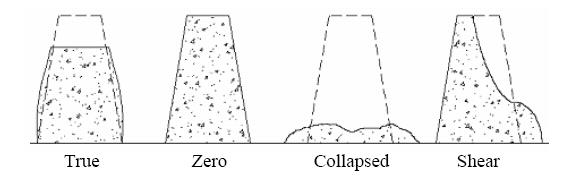
When the slump test is carried out, following are the shape of the concrete slump that can be observed:
Figure-3: Types of Concrete Slump Test Results

True Slump – True slump is the only slump that can be measured in the test. The measurement is taken between the top of the cone and the top of the concrete after the cone has been removed as shown in figure-1.
Zero Slump – Zero slump is the indication of very low water-cement ratio, which results in dry mixes. These type of concrete is generally used for road construction.
Collapsed Slump – This is an indication that the water-cement ratio is too high, i.e. concrete mix is too wet or it is a high workability mix, for which a slump test is not appropriate.
Shear Slump – The shear slump indicates that the result is incomplete, and concrete to be retested.


Ready Mix Concrete Advantages & Limitations

Ready mix concrete is a tailor-made concrete which improves durability and sustainability. Instead of purchasing the raw materials by individuals and experimenting every time with handling and proportioning, it would be far better idea to entrust all these activities to some expert supplier who is having a professional acumen.

Work Ability Tests At Site & Recommended Values

What is workability of concrete? Which test is generally performed at site for its determination? And what are its recommended values for different purposes?
Workability of concrete describes the ease or difficulty with which the concrete is handled, transported and placed between the forms with minimum loss of homogeneity.